How to rebuild the engine top end on your 1994 – 2001 Yamaha YZ125.
Rebuilding the top end on your Yamaha YZ125 is fairly simple, but there are a lot of steps and procedures to keep track of.
Creating one long rebuild guide would be hard to navigate, so I have broken each part into steps that are linked at the bottom of each step.
Making separate pages for each step also makes the tools and parts list, as well as the
torque and service specifications easy to keep track of!
Service Notes:
- 1994 – 2001 Yamaha YZ125s came with five slightly different top-end sizes. The standard piston and cylinder sizes are not marked, but the other four are marked A B C, and D on the piston and cylinder.
- I will be showing the standard size, because that’s what I have.
- Here is a link to the full top end specs with the different sizes.
- Top End Specs
Pre-Service:
- Secure your bike on a stand with the body and exhaust removed, and the cooling system drained and disconnected.
- Start by removing the exhaust valve linkage cover, then disconnect the exhaust valve linkage.
- If you want to service the exhaust valve governor, remove the right crankcase cover.
Top End Tools
You will need a few specialty tools in addition to the hand tools I’ve listed in the individual steps.
Cleaning Tools
You will be cleaning carbon buildup on the cylinder head, inside the cylinder, and the exhaust valve components.
All you will need is a scouring pad for the cylinder head, but for the exhaust valve parts, I like to use a wire brush on a drill and a Dremel with a sanding wheel.
- Dremel with Sanding Disc → https://amzn.to/47fiJR8
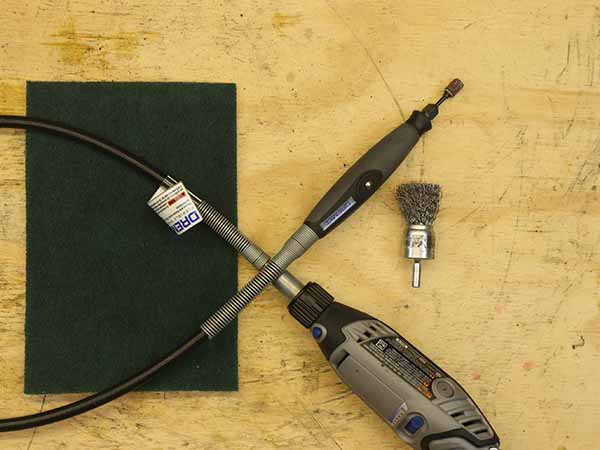 Your cylinder is Nikasil plated, so you will need a honing brush, a scouring pad, and time to safely de-glaze it.
Considering a honing brush costs $80, I use a scouring pad and make the time.
You CANNOT Use A Ball Hone On Nikasil Plating!
However, if your cylinder has been bored and sleeved, you can use a ball hone to quickly de-glaze and crosshatch. A ball hone costs around $40.
- Flex Ball Hone → https://amzn.to/49ru1D8
Cylinder & Cylinder Head Inspection Tools
You will need a machinist’s straight Edge, feeler gauges, telescoping bore gauges, and calipers for inspections.
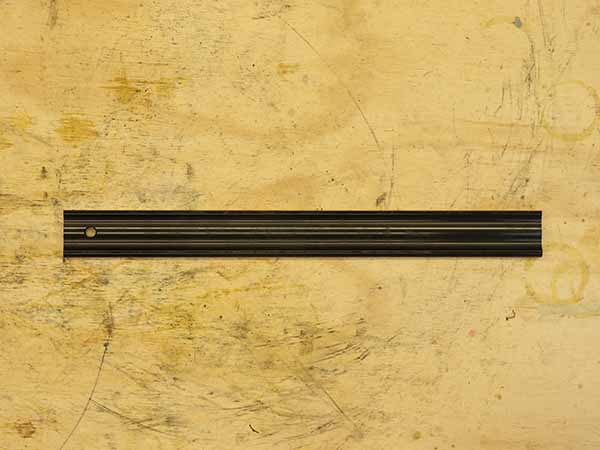 A machinist’s straight Edge is simply a straight, straight edge.
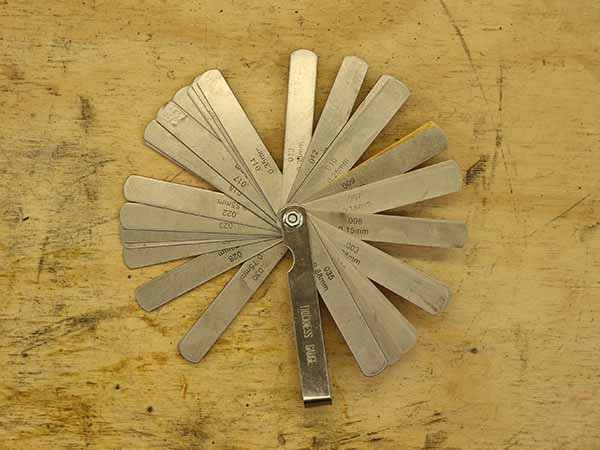 A feeler gauge is a bundle of thin metal strips with varying thicknesses that let you measure small gaps.
We will use the machinist’s straight Edge and feeler gauge to measure warp limits.
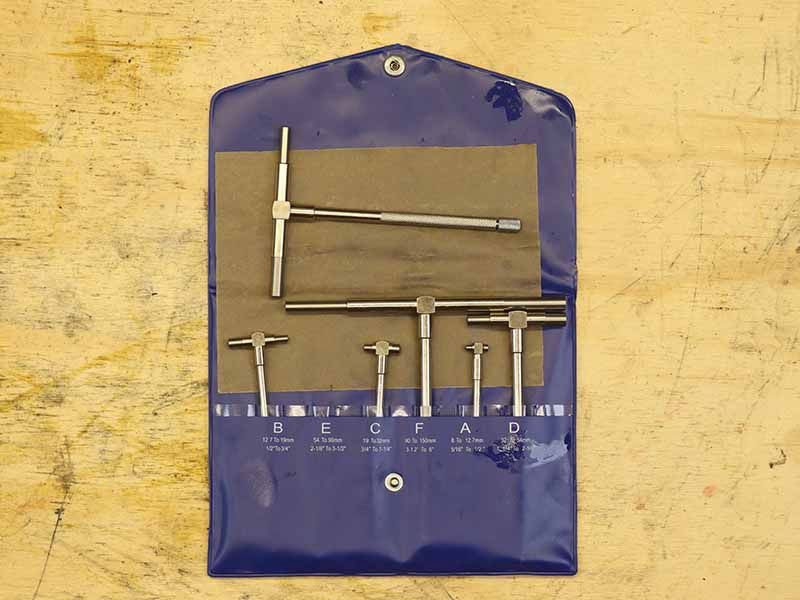 Telescoping bore gauges are used to measure interior diameters.
Compress the telescoping arms, Insert the gauge into the opening you need to measure, find the median measurement, then tighten the screw at the end of the handle to keep the arms in place.
Because the ends of the gauge are spring-loaded, all you need to do is wiggle it a few times, and it will find the median measurement on its own.
One important note about bore gauges is that you need to make sure they are perpendicular to the surface you are measuring.
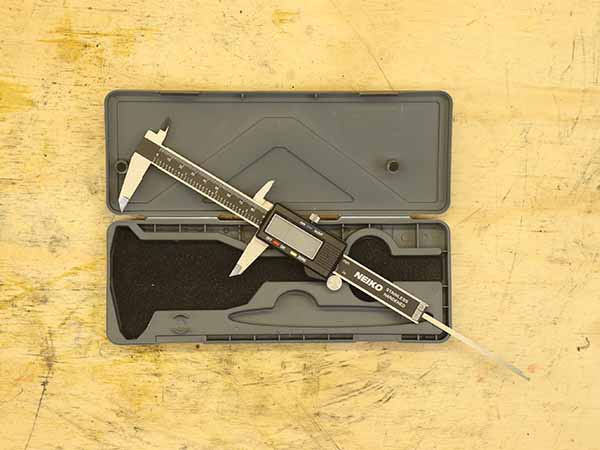 After setting your gauge, you must measure it with calipers. Ideally, you would use a dial micrometer because the bore gauge will sit on each end. Dial micrometers can be very expensive, so I am using a set of regular calipers.
If you use regular calipers, you must take your time to position the bore gauge between the caliper arms just right.
When you find your measurement, DO NOT let the telescoping arms snap back to position.
Hold the arms while you loosen the set screw and let them gently reset.
Inspection Tool Cost
- Machinists Straight Edge → https://amzn.to/3LdJOvq
- Feeler Gauge → https://amzn.to/4nrpkwx
- Telescoping Bore Gauges → https://amzn.to/4qAccrD
- Digital Calipers → https://amzn.to/48VQeJA
Miscellaneous Tools You May Not Have
You will need to use a plastic scraper to clean the mating surfaces. This is a flat razor, but it is plastic.
You will need a spark plug thread follower to true the spark plug threads on the cylinder head. The Motion Pro Torque Wrench Adapter is also needed for the cylinder base nuts because you can’t get anything else on three of the four nuts.
When using the adapter, keep it at a 90-degree angle to your torque wrench to maintain an accurate measurement.
Miscellaneous Tool Cost
- Plastic Scraper → https://amzn.to/3JB1Bfy
- Spark Plug Thread Follower → https://amzn.to/4oDk3TI
- Motion Pro Torque Wrench Adapter → https://amzn.to/48VZRb0
Rebuild Supplies
As far as assembly lubricant, I want to use Lucas Assembly Lube. It’s not critical, but I already have it, and I like to use it. You can get away with 2-stroke oil but you have to use a lot of it.

Top-End Rebuild Supplies
- Lucas Assembly Lube → https://amzn.to/434TgYb
- 2-Stroke Oil → https://amzn.to/4hxAvCy
Top End Rebuild Parts
As a general rule, I never buy parts before I start unless they are mandatory replacements, like gaskets and O-rings.
For example, unless you are dead set on installing an aftermarket piston, hold off on buying one until you look at your old one. If it’s undamaged and within specs, you can reuse it with new rings and pin clip.
You will need a gasket set (I am using the Tusk Complete Top End Gasket Kit), cylinder alignment dowels(Honda OEM), and an O-Ring for the exhaust valve cap (also Honda OEM).
Top-End Service Parts Cost
- Top End Gasket Kit → https://amzn.to/3WwehY4
- Exhaust Valve Cap O-Ring → Included with gasket kit
- Piston Kit → https://amzn.to/3KXHY1w
Precautions
All you need to do is Take Your Time and stuff a shop towel in every hole you open, and your top-end rebuild will go smoothly.
Shop Setup
Make yourself a clean workspace with plenty of room for tools and supplies. Ideally, this workspace can be used for a few days if you can’t do everything at once.
I taped a large trash bag to the top of my workbench to protect the wood.
During inspection and assembly, I used an old hand towel. This protects the components I am working on. It ensures my workspace is free of contaminants, and if I drop a small part, it won’t bounce away.
You will also need access to a hot water source. If all you have is a bathtub or kitchen sink, be ready to clean them thoroughly when you’re done.
2-Stroke Top End Rebuild Time & Cost
It’s hard to say how long a complete top-end rebuild will take, but set aside a full day to complete it.
This service will cost between $20 and $400, depending on the tools you already have and the parts you need.
And if you need to send parts out to be machined or refinished, the cost could be $1,000 or more.
For example, a full cylinder re-plating can cost upwards of $400.
If you have any questions before you start your top-end service, please let me know in the comments or shoot me a DM.
I highly recommend watching this video all the way through before you start your rebuild.
Now, let’s get started! → Part 1: Cylinder Head Removal